

By Ts. Myagmarbayar
The government must distinguish between two forms of civil society participation
The Global Organized Crime Index 2025 highlights a troubling phenomenon in its assessment of organised crime risks associated with Mongolia’s mining sector.
It records cases in which certain groups, presenting themselves as civic movements defending local interests, demand payments from mining companies. This underscores the need to distinguish the voices of residents whose rights have genuinely been violated from groups opposing mining projects for financial or other interests.
Commenting on this aspect of the research, D. Tegshbayar, an external adviser to Transparency International Mongolia, said: “The government is not distinguishing between these groups.”
This raises an important question for the government: how can it distinguish genuine civic participation from organised pressure driven by financial and political interests?
On the one hand, the rights of people genuinely affected by mining must be protected. On the other, pressure exerted on companies under the banner of “protecting local interests” must also be addressed.
The index separately notes that Mongolian civil society organisations actively combat organised crime, conduct research and provide services to victims, while themselves facing pressure and restrictions. Its findings therefore do not suggest that civil society as a whole is problematic.
In countries such as Australia and Canada, where mining is well developed and media literacy is high, opposition to mining is not pursued as a dedicated means of making a living. The presence of this phenomenon in Mongolia and some African countries is directly linked to livelihoods, education and corruption.
Misleading information takes root and attracts public support
Online, those exerting pressure can come to be seen as “courageous citizens” or “fighters for justice,” and some people continue to accept their claims without scrutiny. Under the banner of patriotism, false and misleading information fuels public anger, gradually gaining enough acceptance to attract donations and support.
One example is B. Khukhuu, head of the NGO “Power of Unity, for the Homeland,” who has spent nearly 20 years establishing himself as an “anti-uranium activist.” He has published hundreds of thousands of posts on this subject alone, including a considerable amount of inaccurate, misleading and deliberately distorted information.
A recent example came on September 22 and 23, when he shared a post claiming that “a sulphur smell in Sainshand has been accompanied by the deaths of numerous animals and birds,” adding his familiar explanation that it was caused by “uranium poisoning.”
In fact, the smell came from Sainshand’s wastewater treatment facility. Local broadcaster Dornogovi TV interviewed an authorised environmental official and reported that no birds or animals had died. The provincial authorities had even established an emergency working group in response to the claims.
Officials said they had searched for the alleged carcasses to collect samples but found none. An authorised source said: “The account named ‘Khukhuu Khukhuu’ had deleted the post containing photographs of supposedly dead birds and animals.”
An odour alone had thus prompted alarming online claims attributing it to sulphur and uranium. The information had not been verified, and the way it was presented suggested another purpose. There are many similar examples.
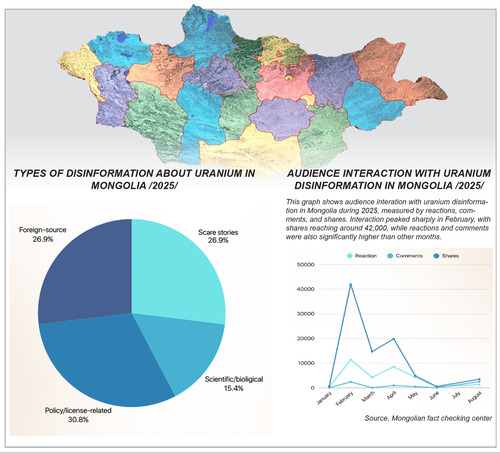
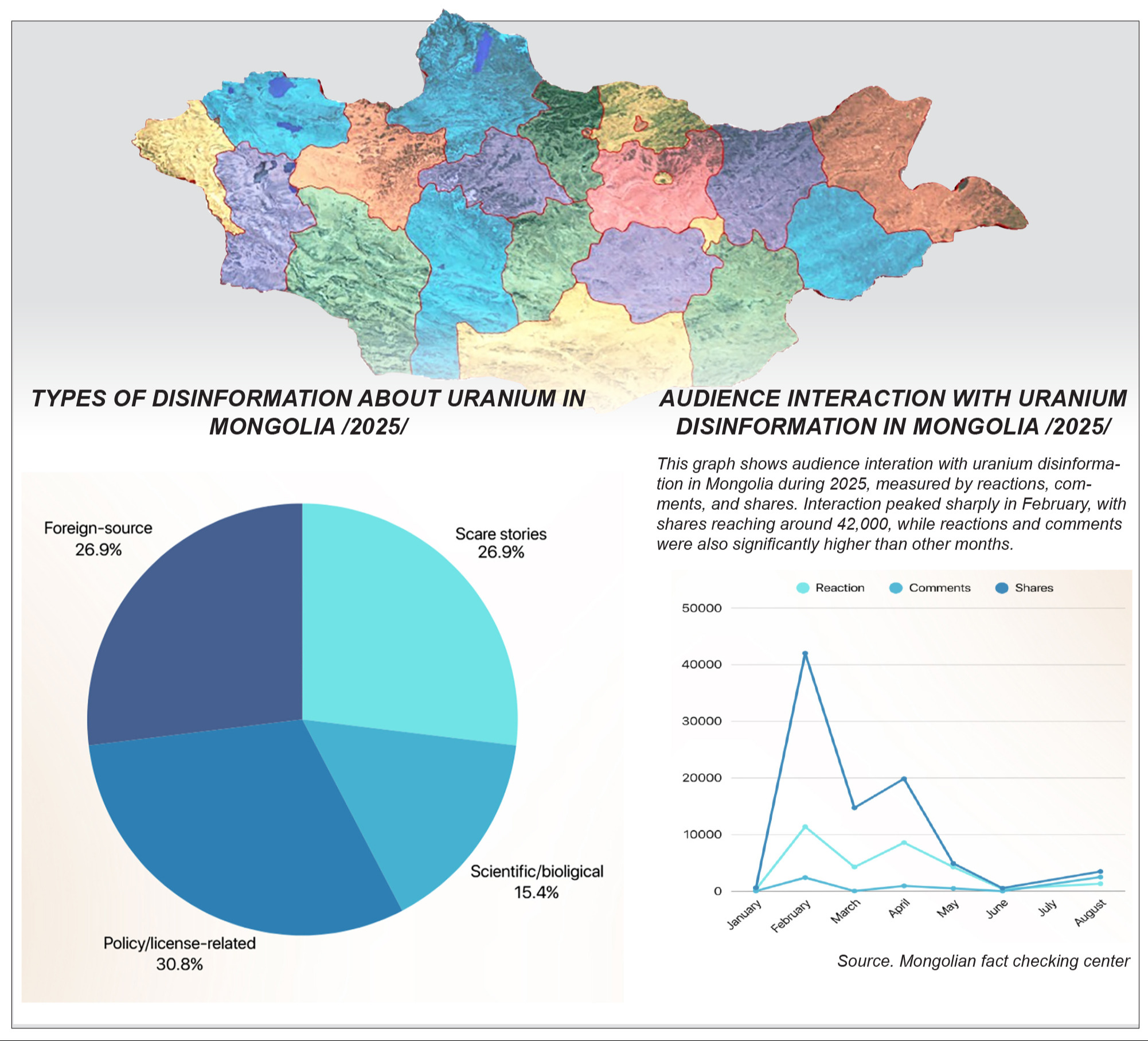
According to the Mongolian Fact-Checking Centre, some misleading posts about uranium have been shared hundreds or thousands of times. A claim that “109 new uranium licences have been issued” was shared more than 1,800 times; a post about “livestock poisoned by uranium” more than 3,900 times; and a claim beginning “1,600 tonnes of sulphuric acid are needed to extract 10 tonnes of uranium…” 403 times.
These figures concern posts from just one individual. The wider circulation by people who believe and share such information illustrates how quickly falsehoods spread.
Sustaining efforts to manipulate public opinion through misleading information over such a long period requires substantial support in both content and financing. That issue will be examined in a subsequent article. For now, let us turn to the opportunities Mongolia has lost and the precautions needed ahead.
What does Kazakhstan’s uranium industry reveal about Mongolia’s missed opportunities?
Mongolia has abundant uranium resources, yet its major Zuuvch-Ovoo project has spent years in research, trials and negotiations before reaching the conditions needed for commercial production.
The deposit’s mining licence was obtained in 2015, and pilot production began in 2021. An investment agreement between the Mongolian and French sides subsequently paved the way for commercial production. The project is planned to operate for 30 years, with an annual production capacity of 2,500 tonnes of uranium. Investment is estimated at US$1.6 billion, with approximately 1,600 jobs expected to be created.
Kazakhstan developed its uranium industry earlier and became a major global producer. In 2025, it produced 25,839 tonnes of uranium, accounting for approximately 40 per cent of global output. That is roughly ten times Zuuvch-Ovoo’s planned annual capacity.
How, then, should Mongolia’s missed opportunity be measured?
Under a hypothetical scenario in which Zuuvch-Ovoo had produced 2,500 tonnes annually from 2010, cumulative output for 2010–2026 would have reached 42,500 tonnes. A simple calculation using current uranium prices gives approximately MNT 30.1 trillion in sales revenue.
Using a late-September 2026 spot price of approximately US$89.8 per pound, the calculation is:
42,500 tonnes × 2,204.62 pounds × US$89.8 ≈ US$8.42 billion.
At an exchange rate of MNT 3,570 to the dollar, this equals approximately MNT 30.1 trillion.
However, this figure cannot simply be called “Mongolia’s lost GDP.” Sales revenue does not translate entirely into GDP. The contribution would depend on extraction costs, investment, imported inputs, tax arrangements, domestic procurement and other factors.
Economists say the calculation can instead serve as the basis for a scenario examining the scale of economic activity that might have been generated had the project begun in 2010.
The missed opportunities extend beyond sales revenue. An earlier start to uranium production could also have supported mining services, engineering, chemical technology, transport, processing, skilled workers and networks of local businesses.
The more meaningful comparison is therefore not simply between Kazakhstan’s output of more than 25,000 tonnes and Mongolia’s planned 2,500 tonnes. Kazakhstan used those years to build an entire uranium production ecosystem, while Mongolia missed the opportunity to do so.
The broader loss lies in the cumulative benefits that exports, tax revenues, jobs, technology, skilled workers and supporting industries could have generated over many years.
Lost opportunities cannot be measured in money alone
Some researchers argue that Mongolia has missed several opportunities to build not only uranium export revenues, but also an industrial base, skilled workforce, technology, processing capacity and a position in international markets.
Mining took place at the Dornod uranium deposit between 1989 and 1995, producing approximately 535 tonnes of uranium, according to recorded figures. Production of around 2,400 tonnes had been envisaged.
Some industrial infrastructure for uranium processing and transport had also been established. When operations stopped, Mongolia lost an opportunity to develop an integrated production chain covering extraction, processing, chemical technology, transport and exports.
Another major opportunity involved efforts to restart operations at Dornod. The dispute over the cancellation of Khan Resources’ licences went to international arbitration. In 2015, an award against Mongolia set principal compensation at US$80 million, with interest and costs taking the total above US$100 million. In 2016, the parties settled the dispute for US$70 million.
The consequences cannot be measured solely by the arbitration payment. The wider issue is that opportunities to attract sustained investment and develop contractual arrangements, technology, skilled workers and export infrastructure were delayed for years.
“Lost opportunity” therefore means more than revenue not earned today. It includes the value of the industries, technologies, workforce, markets, investment and industrial supply chains that could have emerged.
Will Mongolia lose another opportunity?
For Zuuvch-Ovoo, the question remains whether Mongolia will repeat the missed opportunities of its uranium sector. Part of the debate concerns in-situ recovery technology, water, waste, the environment and livestock health.
KATCO, the Kazakhstan-based joint venture between Orano and Kazatomprom, was established in 1996 and has used in-situ recovery, or ISR, since 2006. It now has a production capacity of up to 4,000 tonnes of uranium annually.
Put simply, this technology uses a specially formulated solution to dissolve uranium within the underground ore-bearing layer, rather than excavating the ore itself. The uranium-bearing solution is then brought to the surface through wells for processing.
Compared with conventional open-pit mining, it requires less large-scale overburden removal, ore crushing and stockpiling.
But “no excavation” does not mean “no risk.” Isolation of groundwater layers, control of solution movement, well monitoring and rehabilitation are critical components of the technology.
The uranium debate should therefore begin with practical questions about the technology, standards and oversight involved, rather than dividing the issue into the two extremes of “dangerous” and “safe.”
The Zuuvch-Ovoo project is expected to generate approximately 250 tonnes of very low-level waste annually, including pipes, filters, laboratory materials and protective equipment.
Views on the project’s environmental and livestock health implications remain divided. According to Badrakh Energy, monitoring and research conducted by Mongolian public agencies and international organisations between 2013 and 2023 found no evidence that uranium exploration or pilot production had adversely affected human or livestock health.
Some civil society organisations dispute this position and have raised concerns about local residents’ health, water and pastureland.
In these circumstances, regular, independent and publicly accessible monitoring is essential, rather than relying solely on either company research or opponents’ claims.
The 2026 environmental management plan includes groundwater monitoring points, waste monitoring and other environmental oversight activities.
Zuuvch-Ovoo offers Mongolia an opportunity to recover some of the ground lost in its uranium sector. Lasting trust, however, will depend on keeping information about water, the environment, livestock health, waste and economic benefits open to the public.
How uranium recovery works: an underground coffee filter
A simple analogy is to think of extracting uranium underground through a liquid, rather than digging out all the material containing it.
It resembles passing hot water through ground coffee to draw its flavour into the water. Naturally, the process uses a specially formulated solution rather than coffee. The solution enters the uranium-bearing layer underground, dissolves the uranium and is brought to the surface for processing.
The principle is to leave the rock underground while extracting the required substance. Drawing the resulting liquid back up through pipes can, in turn, be compared to drinking coffee through a straw: solution is injected into the uranium-bearing zone and then pumped back to the surface.
One advantage is that the process requires relatively little of the large-scale overburden removal and piling associated with open-pit mining.
Injecting a solution underground is nevertheless not risk-free. Isolation of groundwater layers, control of solution movement, well monitoring and rehabilitation remain central to the process.
The discussion should therefore start with the technology, oversight and standards used in extraction, rather than treating uranium as either inherently “toxic” or entirely “safe.”
Providing clear public information about this technology is particularly important in Mongolia. Understanding how uranium is recovered underground and how water and the environment are protected provides a basis for decisions grounded in evidence rather than fear, explains State Prize-winning physicist Dr N. Tegshbayar.
At Zuuvch-Ovoo, operations are expected to generate domestic waste and small quantities of radioactive waste, including pipes, laboratory equipment and protective clothing. The estimated maximum is 250 tonnes annually. Waste is to be stored in an engineered facility and managed in accordance with the investment agreement’s requirements.
To improve understanding of the technology, specialists from Orano, Mining College and Badrakh Energy have organised training and seminars at the National University of Mongolia and the Mongolian University of Science and Technology since 2024. More than 110 lecturers and students have participated in six training modules.
Public concerns remain that Zuuvch-Ovoo’s operations could affect the environment and livestock health. In response, Badrakh Energy has conducted livestock health research and support programmes in the project area since 2014.
According to the company, monitoring and research by Mongolian public agencies and international organisations between 2013 and 2023 found no evidence that uranium exploration or pilot production had harmed human or livestock health.
It also reports that studies and assessments conducted in 2023–2025, after pilot production ended, identified no exceptional livestock health conditions around Zuuvch-Ovoo.
Research has instead identified excessive grazing pressure, feed shortages, water availability and climate change as possible major factors affecting livestock disease and productivity in Dornogovi Province. One estimate places grazing pressure at 1.3–3.4 times the pasture’s carrying capacity.
There is, however, an important principle here: company research, public oversight and residents’ concerns must all be taken seriously.
Building trust in a uranium project requires an independent, regular and publicly accessible monitoring system. Zuuvch-Ovoo can help Mongolia recover opportunities previously lost in the sector, but lasting public trust will depend on transparency about the environment, water, livestock health and waste.
Accountability for missed opportunities must also be addressed
Blaming those who spread false information about uranium is not enough. The government must provide clear, timely primary information about mining projects. Companies must fully disclose risks and environmental information, while independent researchers must base their conclusions on evidence.
Rumours fill the space left by missing information.
If government, companies, civil society and the media make primary evidence publicly available, public fears and suspicions can be tested against facts rather than addressed through publicity alone.
Over many years, Kazakhstan has developed its uranium resources into an ecosystem of production, exports and technology. For Mongolia, Zuuvch-Ovoo marks a starting point on that path.
This time, Mongolia must decide not only whether to extract uranium, but whether it can demonstrate transparency, independent oversight, scientific evidence and economic benefits throughout the process.
Creating a new opportunity is not enough to recover what was previously lost. A system capable of managing that opportunity properly is also needed.
To be continued…
Produced in the public interest by the “Facts First” network as part of the “Ask-2” campaign against false information and manipulation.
Эх сурвалж: “Зууны мэдээ” сонин
2026 ОНЫ АРАВДУГААР САРЫН 2. БААСАН ГАРАГ. № 186 (7928)
Хуурамч мэдээлэл хаа сайгүй тархах болсон энэ үед баримттай, эх сурвалжтай, үнэн бодитой мэдээллийг “Зууны мэдээ” сониноос аваарай.
Үнэн мэдээллийг хамтдаа хамгаалцгаая.
Бие даасан сэтгүүл зүйг дэмжин "Зууны мэдээ" захиалаарай. www.zuuniimedee.mn