



By B.Nyamsuren
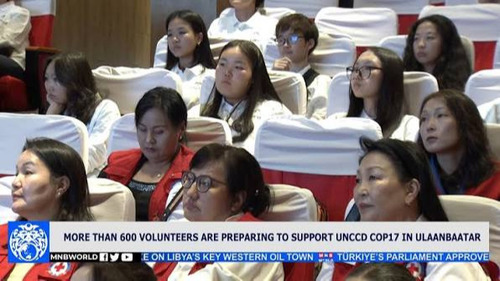
The 17th session of the Conference of the Parties to the United Nations Convention to Combat Desertification (UNCCD COP17) is continuing in Ulaanbaatar, bringing global attention to land degradation, drought, water security and the future of rangelands.
During the first four days of the conference, governments, international organizations, financial institutions, businesses and experts have discussed not only how to restore degraded land, but also how to finance that restoration.
Alongside the official negotiations and high-level meetings in the Blue Zone, the Green Zone is bringing COP17 closer to the public. It provides a space for civil society, young people, communities and other stakeholders to exchange ideas and showcase initiatives related to land restoration, drought resilience and sustainable development.
The urgency of the challenge was underlined by Dr. Yasmine Fouad, Executive Secretary of the UN Convention to Combat Desertification (UNCCD).
“We need to focus our investments on healthy soils, pastures, and human-centered initiatives, as land plays a fundamental role in water and food security,” she said.
Dr. Fouad noted that 77% of Mongolia's territory is affected by land degradation, while the country's economy and population remain closely connected to pastoralism. Globally, she said, around 40% of the Earth's land has already been degraded, largely as a result of human activity and overexploitation.
She also stressed the importance of involving the private sector in financing and agriculture so that decisions made at COP17 can be translated into practical action.
Mongolia launches Green Finance Corporation
One of the most significant developments during COP17 was the official launch of the Mongolian Green Finance Corporation (MGFC) in the Blue Zone.
Prime Minister N.Uchral attended the ceremony and joined representatives in ringing the bell to mark the corporation's official launch.
MGFC aims to channel financing through Mongolia's banking sector into green projects, including energy efficiency, renewable energy, household insulation and energy-efficient housing. Over 15 years, its activities are expected to help reduce carbon dioxide emissions by approximately 3.8 million tonnes.
The launch reflects one of the key messages emerging from COP17: environmental financing should increasingly be viewed as investment rather than expenditure.
Another major event was the High-Level Sustainable Finance Forum 2026, held on August 19–20.
At the forum, A.Uilstuguldur, Chief of Staff of the Office of the President of Mongolia, highlighted that at least US$355 billion in investment is needed annually by 2030 to restore degraded land worldwide.
The scale of this financing gap means restoration can no longer depend solely on government budgets, international assistance and grants. Banks, investors and private businesses will also need to become part of the solution.
This is particularly relevant to Mongolia. When rangelands deteriorate, livestock productivity and herder incomes can decline, eventually affecting businesses and the financial sector. Water scarcity can similarly increase risks for mining, agriculture, industry and energy.
In other words, land degradation and water scarcity are increasingly becoming financial risks as well as environmental ones.
Mongolia is also advancing its SDG Finance Taxonomy, designed to establish common criteria for determining which economic activities can be considered sustainable and eligible for sustainable financing.
COP17 will continue in Ulaanbaatar until August 28, bringing together delegates from more than 190 countries to address desertification, land degradation and drought.
While negotiations are still underway, its first days have already highlighted an important shift: restoring land is no longer only about environmental policy. It is also about where banks lend, where investors put their money and how capital can be directed towards land, water and nature.
For Mongolia, the launch of new green financing mechanisms could become one of the conference's most tangible legacies.
Source: Zuuniimedee № 156 (7898) August 21, 2026
In an age of widespread misinformation, choose facts you can trust.
Zuunii Medee delivers verified, credible, and reliable news. Stand with the truth.
Support independent journalism — subscribe Zuunii Medee today. www.zuuniimedee.mn