


By P.Amgalanbayar
“If I write falsely or inaccurately about the history of Mongolia and Chinggis Khaan, may heaven punish me,” said renowned Buryat writer A.S. Gatapov of Russia, a statement that clearly reflects the responsibility and dedication he brings to his literary work.
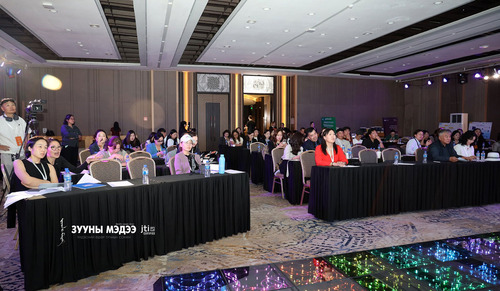
Yesterday, the launch of his novel “Young Temüjin” took place at the Chinggis Khaan National Museum. The work has been translated into Mongolian by award-winning writer and translator N. Purevdavga, and is now ready to reach readers in refined and expressive Mongolian language.
At the book launch, A.S. Gatapov shared his thoughts: “I began writing this book in 2001 and completed it in 2021. In other words, it is a work that contains 20 years of effort. When I first started, I did not know when it would be finished, but I devoted all my strength to delivering a truthful account to readers. At that time, many historical novels were being published. However, as both a writer and a historian, I was not satisfied with those works in terms of artistic quality and content. Perhaps it was difficult to portray detailed events while covering such a long historical period.
In my novel, I focused on a four-year period in Temüjin’s life, between the ages of 9 and 13. This was a crucial moment—like Shakespeare’s ‘To be or not to be’—when it was being determined who Chinggis Khaan would become. These four years were significant not only for Temüjin, but also for the future of entire regions: whether Russia would exist, whether China would exist, whether the states of Central Asia would exist. In other words, if there had been no Chinggis Khaan, it is difficult to say where world history would have headed,” he said.
The translator of the work, award-winning writer and translator N.Purevdavga, also shared his views:
“To be honest, I am not sure what to say or what I should say. First, I would like to mention something. I often reflect on the words ‘translator’ and ‘betrayer.’ I have worked as a translator for more than 50 years. Yet I always fear that someone might say, ‘Instead of translating, he has ruined the book.’
“I recently spent half a day attending the first national conference of Mongolian teachers, where much attention was given to fundamental academic works—how teachers engage with them and how they explain them. Since you will read this book yourselves, there is no need to say too much. But one thing is clear: this is a literary work. It is not purely a scientific or research work. Yet, in another sense, it can also be considered one”.
Over the past two or three years, I have come to understand how A.S. Gatapov worked on this book. Before writing this five-volume work, he compiled his own detailed historical reference, organizing chronology, names, and lineages of Mongolian history. In that sense, it can indeed be considered a scholarly work. At the same time, its style and language are simple and accessible. It seems the sixth volume is not yet completed.
Another thing—I completed the translation in a very short time, within three to four months. I became so absorbed in the book that I worked up to 18 hours a day. In a way, I felt almost ‘enchanted’ by Gatapov. That is why I believe it must be a good work.
When Gatapov spoke about the historical novels written in the early 2000s, I shared the same feeling. I often thought, ‘This is not the true history of my Mongolian ancestors.’ There were works that portrayed Mongols as cruel and barbaric people. Reading such depictions filled me with anger and pride, and that same emotion drove me to complete this translation in just a few months. I am now ready to continue working on the next volumes. Since two volumes have already been published, it is up to readers to evaluate them. If they are accepted, that is good. If not, I do not feel the need to insist,” he said.
He further emphasized: “This is a book that can give wings to ordinary Mongolian children.”
People’s Writer D. Uriankhai also spoke at the event, saying: “Since my youth, I have admired two professions—historians and mathematicians. I feel both grateful and humbled to meet history teachers. It is significant that the launch of ‘Young Temüjin’ coincides with the first national conference of history teachers, held under the auspices of the President of Mongolia.”
Teachers from both the capital and rural areas attended the event. During the ceremony, Academician S. Chuluun, Director of the Chinggis Khaan National Museum, noted: “By selecting a careful and skilled translator, the essence and beauty of the work have been fully conveyed in the Mongolian language. I encourage teachers to widely promote this work among students and wish that many future Chinggis Khaans and Temüjins will be inspired.”