

By B.Nyam
Ulaanbaatar has officially launched its first wastewater recycling plant, marking a major step toward improving water sustainability and infrastructure in Mongolia’s capital.
The project is part of the second Compact Agreement between the Government of Mongolia and the U.S. Millennium Challenge Corporation (MCC), with a total investment of $462 million. Of this, $350 million is a grant from the United States, while Mongolia has contributed $111 million.
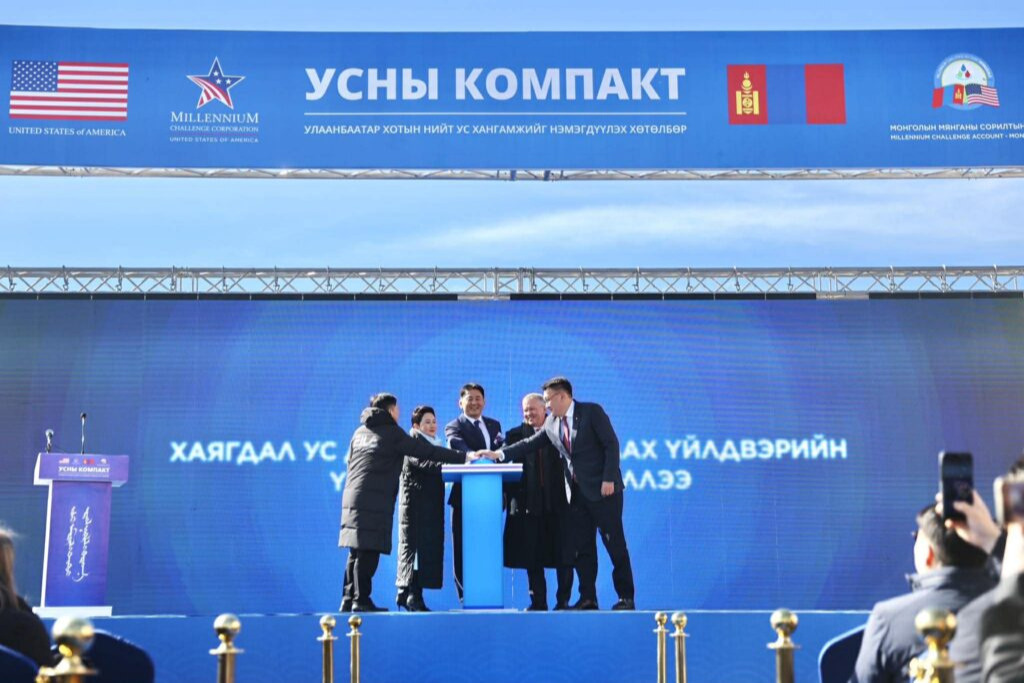
President U.Khurelsukh attended the opening ceremony of the plant, which is located next to the new Central Wastewater Treatment Facility. Senior government officials from Mongolia and representatives from the United States also took part in launching the plant’s operations. U.S. Assistant Secretary of State for East Asian and Pacific Affairs, Michael George DeSombre, attended the launch of Ulaanbaatar’s first wastewater recycling plant, highlighting growing cooperation between Mongolia and the United States.
Speaking at the event, President U.Khurelsukh described the project as a symbol of partnership between Mongolia and the United States and expressed appreciation to all organizations, engineers, and experts involved in its implementation.
He also emphasized the importance of ensuring reliable operation of the plant, improving efficiency, and expanding the use of recycled water across key sectors, including mining, infrastructure, agriculture, and urban services.
Assistant Secretary DeSombre noted that the project provides Mongolia with a reliable source of recycled water for industrial purposes and helps create favorable conditions for future investment and cooperation.
Currently, thermal power plants in Ulaanbaatar consume around 21 million cubic meters of water annually, accounting for about 24% of the city’s total water use. Most of this water comes from underground sources.
The new facility will recycle up to 50,000 cubic meters of treated wastewater per day and supply it to Power Plants No. 3 and No. 4. This will significantly reduce the need for groundwater, saving more than 18 million cubic meters of clean water each year—equivalent to half the annual water consumption of over 100,000 households.
Officials highlighted that the project will help conserve scarce water resources, support industrial use of recycled water, and protect environmental balance. It is also expected to create better conditions for investment and future economic growth.
The plant was built with supporting infrastructure, including pipelines, reservoirs, and pumping stations. The project’s main contractor is MCS Property, while the design was developed by France-based Egis Water and Maritime and Veolia Water Technologies.
Another major facility—a water purification plant—is expected to be completed in May. Together, these projects will increase Ulaanbaatar’s water supply capacity by up to 80% and help ensure stable access to clean water for more than 2.4 million residents over the next 30 years.
This program represents the largest investment in Mongolia’s water sector in the past three decades and is expected to play a key role in supporting urban expansion, new residential areas, and sustainable development.
Source: Zuuniimedee № 53 (7795) March 19, 2026
In an age of widespread misinformation, choose facts you can trust.
Zuunii Medee delivers verified, credible, and reliable news. Stand with the truth.
Support independent journalism — subscribe Zuunii Medee today. www.zuuniimedee.mn