

By B.Nyamsuren
Mongolia’s lowest corruption ranking comes at a time when the world is losing urgency
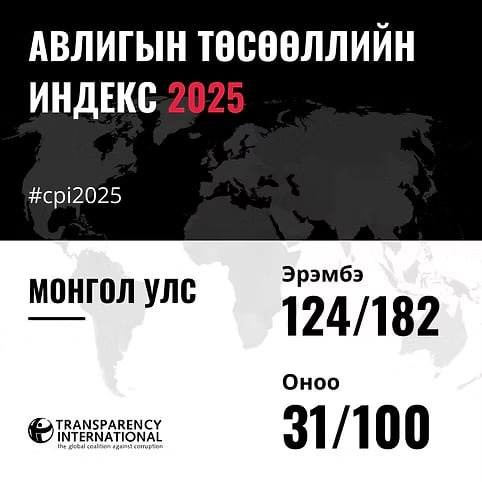
Mongolia has fallen 10 places in the 2025 Corruption Perceptions Index, ranking 124th out of 181 countries. It is the country’s lowest position on record.
The index is published annually by Transparency International and measures how clean a country’s public sector is perceived to be. It does not count individual bribery cases. Instead, it reflects confidence in institutions — whether public power is exercised fairly and transparently.
Presenting this year’s results, François Valérian, Chair of Transparency International, issued a direct warning:
“At a time of climate crisis, instability and polarisation, the world needs accountable leaders and independent institutions to protect the public interest more than ever — yet, too often, they are falling short.”
His message was clear: corruption is not just about money. It is about weakened institutions at a time when strong leadership is needed most.
Mongolia: Why the Ranking Fell
Mongolia’s 10-place drop did not come from a single event. It reflects deeper, long-standing weaknesses.
The economy remains heavily dependent on mining. That dependence creates vulnerability — not only to global price swings but also to governance risks in licensing, contracts and ownership transparency. When rules are unclear or enforcement appears uneven, confidence declines.
Business groups have also raised concerns about regulatory instability and unpredictable policies. Investors prefer consistency. When tax rules, investment policies or enforcement practices feel uncertain, the perception of risk increases. In a perception-based index like this one, uncertainty matters.
There are also concerns about accountability. Some corruption-related actions can be handled under administrative law instead of criminal law, which may create the impression of limited consequences. At the same time, Mongolia still lacks comprehensive whistleblower protection legislation, despite years of discussion. Without clear protection, reporting wrongdoing becomes harder.
Governance standards in state-owned enterprises have also drawn attention. Leadership appointments are not always transparent, and large contracts are not always clearly disclosed. In a country where state-owned companies play a major economic role, this affects overall public trust.
None of these issues are new. But taken together, they have gradually weakened confidence in how public institutions function.
The Global Picture: A Slowing Fight Against Corruption
Mongolia’s decline comes at a time when the global trend is also troubling.
The 2025 index shows that the global average score has dropped to 42 out of 100 — the lowest level in more than a decade. More than two-thirds of countries score below 50. Ten years ago, twelve countries scored above 80. Now only five do.
Denmark remains at the top of the ranking, followed by Finland and Singapore. But even among strong democracies, momentum is fading. Western European countries make up nine of the top ten positions globally, yet anti-corruption progress in the region has largely stalled. In fact, Western Europe’s average score has dropped faster than any other region in recent years.
In Asia Pacific, eight countries have improved since 2012. Yet the region remains deeply divided. In many countries, well-connected elites continue to buy political influence, and laws are often not properly enforced. Commitments to reform are frequently made — but not fully delivered.
In the Americas, years of government inaction have weakened democratic institutions and allowed organized crime to expand, with serious consequences for human rights and public security.
Eastern Europe and Central Asia remain among the world’s lowest-performing regions. Widespread impunity persists, often driven by entrenched interests that dominate political and institutional systems.
In Sub-Saharan Africa, weak democratic structures — sometimes combined with armed conflict and civil unrest — continue to undermine governance, economic stability and development efforts.
Governments in the Middle East and North Africa are still struggling to address public sector corruption, reflecting inconsistent political commitment and weak oversight institutions.
Across regions, the pattern is similar: reform efforts stall, enforcement weakens and urgency fades.
A Shared Warning
Whether countries are facing recent democratic backsliding or struggling with long-standing structural problems, every region has work to do. Yet almost all regions also have examples of progress that show improvement is possible.
That is the broader message behind Mongolia’s 10-place drop.
The ranking is serious. But it is not unique. The world as a whole is facing a slowdown in anti-corruption momentum. When political will weakens and oversight institutions are not fully protected, corruption risks grow quietly.
For Mongolia, rebuilding trust will require clearer accountability, stronger whistleblower protections, greater transparency in political financing and stronger governance standards in state-owned enterprises and the mining sector.
For the world, the lesson is similar. Corruption does not always explode dramatically. It spreads when attention drifts.
Mongolia’s decline is a warning. The global trend makes that warning even clearer.
Source: Zuuniimedee № 31 (7773) February 13, 2026
In an age of widespread misinformation, choose facts you can trust.
Zuunii Medee delivers verified, credible, and reliable news. Stand with the truth.
Support independent journalism — subscribe Zuunii Medee today. www.zuuniimedee.mn