

By B.Nandin
A comprehensive regional report examining the digital transformation of higher education in East Asia has been released in Mongolian, providing new insights into Mongolia’s position and challenges within the region.
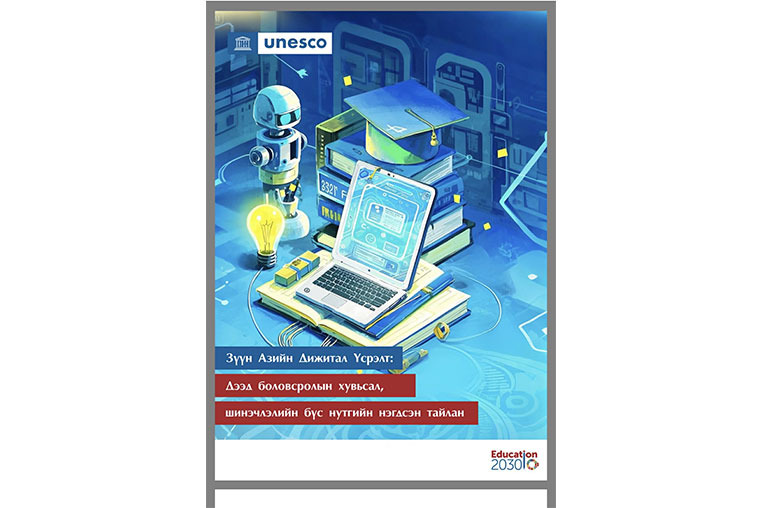
The report, titled “East Asia Digital Leap: Regional Synthesis Report on the Transformation and Innovation of Higher Education,” was produced by the UNESCO East Asia Regional Office in collaboration with the International Centre for Higher Education Innovation under the auspices of UNESCO. Conducted between 2023 and 2025, the study analyses digital transformation processes in higher education institutions across the Republic of Korea, China, Mongolia, and Japan. The Mongolian translation of the report has now been made publicly available, enabling wider access for policymakers, educators, and researchers.
Aligned with UNESCO’s policy framework “Higher Education Roadmap 2030: Beyond Limits – New Ways to Reinvent Higher Education,” the report places strong emphasis on human-centred, technology-driven educational transformation. It assesses policy environments, institutional capacity, and implementation gaps across the four countries.
From a comparative perspective, the report identifies Mongolia as being in a transitional stage of digital transformation. While the basic foundations for online and hybrid learning have been established, particularly following the rapid shift during the COVID-19 pandemic, the report notes that progress has been uneven. Urban universities are better positioned to adopt digital tools, while institutions in rural areas continue to face limitations related to internet connectivity, infrastructure, and access to digital resources.
In contrast, the Republic of Korea and China are highlighted for their system-wide approaches. Korea has integrated digital competencies into faculty development and institutional evaluation frameworks, while China has deployed large-scale, nationally coordinated digital platforms that enable broad access to online education. Japan, meanwhile, is described as pursuing a more gradual and quality-focused approach, balancing technological adoption with institutional autonomy.
The report also underscores challenges related to human capacity in Mongolia. Faculty members’ digital skills are often driven by individual initiative rather than supported through a consistent, system-level policy framework. Unlike Korea and China, where digital competencies are closely linked to career progression and performance assessment, Mongolia lacks a unified mechanism to incentivise and sustain digital skill development among academic staff.
Governance and policy implementation emerge as another key area of concern. Although Mongolia has adopted policy documents supporting digital transformation in higher education, the report points to gaps between policy intent and practical implementation. Limited and inconsistent financing, as well as coordination challenges, have constrained progress. By comparison, other countries in the region have aligned digital transformation more closely with national development strategies and long-term funding mechanisms.
Across the region, the report identifies common issues such as quality assurance in digital learning, ethical use of artificial intelligence, and ensuring equitable access to technology. For Mongolia, however, the risks associated with digital inequality, infrastructure gaps, and sustainable human resource development are described as particularly pressing.
The report also recognises the contribution of Mongolian scholars to the research process. Mongolia was represented in the research team by M.Burmaa, Senior Lecturer and Associate Professor at the Mongolian University of Science and Technology, and B.Oyuntungalag, Professor at the same institution.
Overall, the East Asia Digital Leap report positions digital transformation not merely as a technological upgrade, but as a systemic shift in how higher education responds to societal needs. For Mongolia, the findings offer both a regional benchmark and a strategic reference for shaping future reforms in higher education.
If you would like to read full report, click here.
Source: zms.mn
In an age of widespread misinformation, choose facts you can trust.
Zuunii Medee delivers verified, credible, and reliable news. Stand with the truth.
Support independent journalism — subscribe Zuunii Medee today. www.zuuniimedee.mn