


By B.Nyamsuren
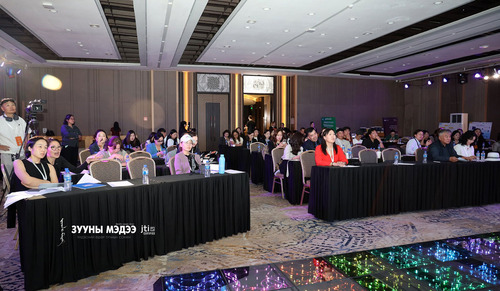
As a journalist, I participated in the short-term co-creation programme titled “The Role of Media in Democratic Countries”, organised annually by the Japan International Cooperation Agency (JICA) and held in late November this year. Representing the Press Council of Mongolia and the Zuunii Medee newspaper, I travelled to Tokyo to take part in the three-week programme. The programme brought together 14 participants from 10 countries, including Mongolia, Serbia, Ukraine, Moldova, South Sudan, Fiji, and Grenada, with the shared goal of strengthening professional journalism and media self-regulation. During the programme, I had the opportunity to speak with Andrii Titok, a journalist from Suspilne, Ukraine’s public broadcasting service, who had also travelled to Japan to participate.
Our conversation focused on Ukraine’s current situation and the role journalists are playing under extremely challenging conditions. The interview took place in Okinawa, following a visit to the Okinawa Peace Memorial, a setting that added particular depth and emotional weight to the discussion.

-Andrii, could you briefly introduce yourself to our readers?
-My name is Andrii Titok. I am the Chief Editor of Suspilne, Ukraine’s public regional broadcaster in the Chernihiv region, which is located in the northern part of Ukraine, near the Russian border. If you look at the map, it becomes very clear what kind of situation we are facing. I came to Japan together with Oleksandra Zakharchenko, Head of the digital content of Suspilne central office, with whom we work closely.
-What brought you to Japan, and what made you decide to join the JICA programme?
-We have long time-standing cooperation with NHK. I want to express my deep gratitude to Japan, the Japanese people, JICA, and NHK. Their support for Ukrainian public broadcasting has been immense. We have long-standing cooperation with NHK, including technical assistance such as cameras, laptops, mobile equipment, and even broadcast transmission vehicles, which are crucial during wartime.
My first meetings with NHK representatives took place in Ukraine in 2019, in Kyiv and Odesa. They shared valuable experience on how to report news under extreme stress and disaster conditions. Thanks to Japanese training methods and operational models, we established backup hubs to ensure continuous broadcasting during emergencies. Japan has truly been a friend to Ukraine.
-From your experience, how would you describe the situation in Ukraine today?
Our region experiences daily missile and drone attacks. Russia uses drones, including Iranian-made Shahed drones, and conducts strikes not only along the front lines in Zaporizhzhia, Donetsk, Kharkiv, and Sumy regions, but also deep inside civilian areas. This is not just a war against soldiers. Civilians are deliberately targeted, along with homes, apartment buildings, markets, and critical infrastructure such as power plants.
In the Chernihiv region, we clearly understand what this means. Just weeks ago, the city centre of Novhorod-Siverskyi, a regional town near the border, was struck several times. There were no military targets there—only a central square, a historical monument dedicated to people from 12th century, shops, and residential buildings. During that, four civilians were killed. One strike was near a hospital, another near a stadium, and another near garages where people lived and worked. This is the reality we report on every day.
-We recently visited the Okinawa memorial. What thoughts did it leave with you?
-As a journalist, it was heartbreaking. Even 80 years after World War II, the pain remains visible. What I saw in Okinawa felt painfully familiar. The artillery, missiles, destroyed landscapes—these are scenes I now see in Ukraine, especially in Chernihiv.
Ukraine has endured both world wars on its territory, and today history feels like it is repeating itself. I was deeply impressed by how Japan has approached memorialization—not just for decades, but for centuries. In Ukraine, we are still searching for the right ways to remember our fallen soldiers and civilians. People act with love and sincerity, but often without long-term vision. Okinawa showed me how remembrance can be done with dignity, depth, and permanence.
-Looking ahead, how do you see your future—and Ukraine’s future?
-Honestly, people in Ukraine do not plan years ahead. We plan one day, two days, maybe a week. Even thinking in months feels unrealistic, because we live under constant threat. Anyone can be killed at any moment—that is the truth we live with.
In the Chernihiv region, attacks continue from across the border. Missiles are launched from Russian territory, striking our towns before moving on to other regions. This uncertainty defines our daily lives.
Still, we continue to work, to report, and to believe that truth matters, even in the darkest times.
Source: Zuuniimedee № 240 (7737)
December 19, 2025
In an age of widespread misinformation, choose facts you can trust. Zuunii Medee delivers verified, credible, and reliable news. Stand with the truth. Support independent journalism — subscribe Zuunii Medee today.